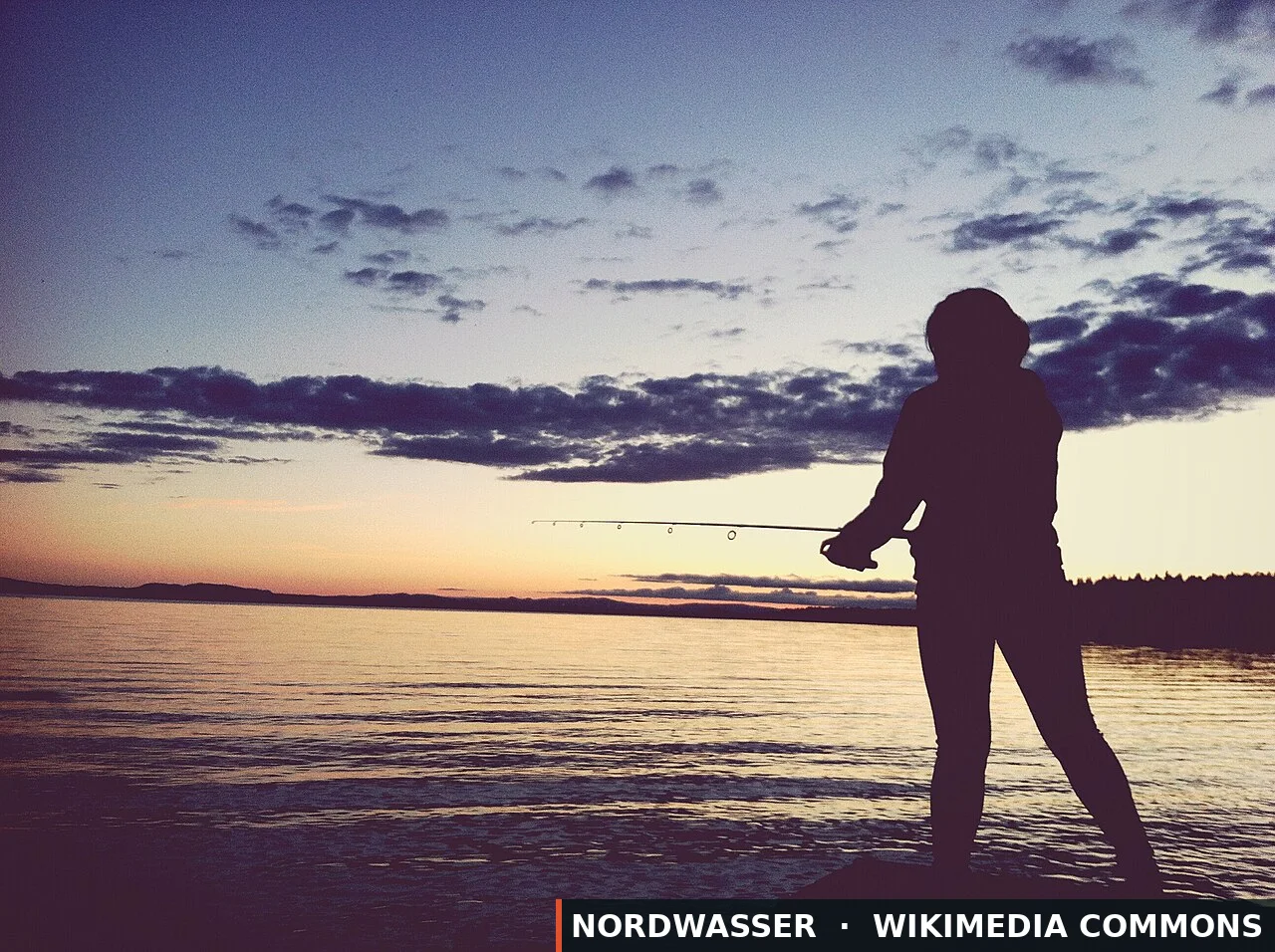
- Scientific name
- Perca fluviatilis
- Swedish name
- Abborre
- Maximum length
- up to 60 cm
- Maximum weight
- up to 3,2 kg
- Spawning
- April–Juni ab etwa 8 °C
- Swedish record
- 3,15 kg · 1985
Technique in brief
The quickest way to get started is with a small soft-plastic lure or drop-shot on fine line along every visible edge. Hunting shoals reveal themselves through small fish fleeing at the surface — there, a quick, accurate cast matters more than any lure colour. In winter, perch moves deeper but continues to feed: jigging through the ice is a discipline of its own in Sweden.
Tackle
A light spinning rod with a casting weight of 5–21 g, 0.10–0.14 mm braided line and a short fluorocarbon leader are sufficient for practically every situation. For ice fishing, a short jigging rod, small mormyshkas and a set of lead-head jigs are sufficient.
Handling the catch
Specimen perch over 40 cm are rare in every population and grow slowly. If you want to release them, hold them beneath the gill cover rather than by the gills and keep them out of the water only briefly. The dorsal fin is spiny but harmless — handle it from front to back.
Season by country
- Jan Good
- Feb Good
- Mar Good
- Apr Quiet
- May Good
- Jun Prime time
- Jul Prime time
- Aug Prime time
- Sep Prime time
- Oct Good
- Nov Quiet
- Dec Good
Prime time · Good · Quiet
The calendar shows bite windows, not closed seasons. Binding closed seasons and minimum sizes are set by the individual water and appear on its page.
Where in Scandinavia
- Fishing for Perch in Sweden 1098 waters
Official sources
Checked: 04.08.2026
Frequently asked questions
When does perch bite best in Sweden?
From June to September, when the water is warm and the shoals are actively hunting. It can still be caught in winter, but holds deeper — jigging through the ice is then the method of choice.
How large do perch grow in Sweden?
Most fish remain under 25 cm. Specimens reach around 60 cm and over 3 kg; the Swedish sport-fishing record is 3.15 kg from 1985.
Do you need a permit for perch?
Not on the coast or in Vänern, Vättern, Mälaren, Hjälmaren and Storsjön. In all other inland waters, yes, issued by the respective holder of the fishing rights.
.jpg?utm_source=nordwasser&utm_medium=referral)

